I'm a marketer who loves to talk about artificial intelligence and food & drink. Subscribe to my newsletter.
Benchmarking Pizza Ordering AI Agents
OverviewThe promise of AI order agents in pizzerias is huge: streamlining ordering processes, offloading work from staff, and boosting overall profit margins. However, pizza orders, with their high-level of customization, complex menu offerings, and lack of standardization across pizzerias present the biggest challenge for AI within the food sector. Benchmarking is more than a buzzword; it’s a vital tool in the AI industry to constantly improve our products. Despite the rapid growth in AI adoption, there is no current benchmark defined for AI order agents. In response, we’ve developed an industry benchmark to share key findings and insights, helping the entire industry move toward better user experiences and greater business efficiency. What defines a great customer experience when ordering pizza? Order accuracy is crucial—mistakes frustrate customers, lead to negative reviews, and increase refund requests, ultimately impacting profit margins. Here’s an example of different customer experiences: 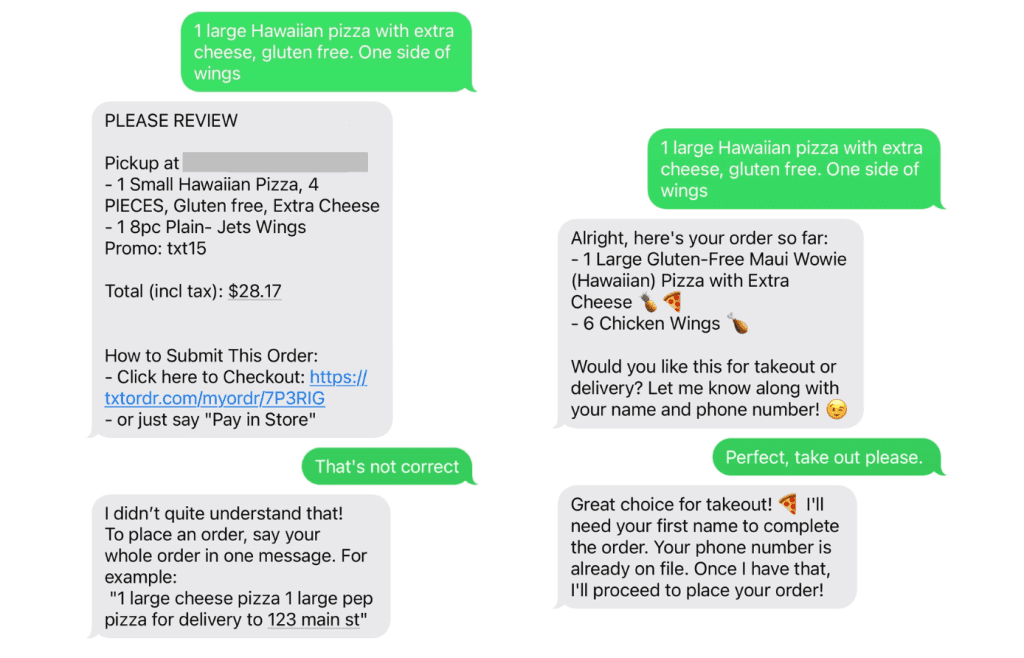 Subpar customer experience:
Good customer experience:
For the rest of this blog, we explore in-depth the process, methodology, and results of our benchmark study. 2. Benchmark DesignThe most fundamental (and most challenging) capability for AI agents is accurately processing highly customized pizza orders. To highlight this, we conducted our benchmark using variations of food items—pizzas, salads, drinks, and sides—and pizza toppings like extra cheese, mushrooms, and Create Your Own (CYO) combinations. 2.1 General CasesSince each AI order agent was designed for different pizzerias with unique menus, we first conducted a general case study to ensure accuracy. Using placeholders like [signature pizza] for pizzas, toppings, salads, and drinks, the generated test cases remained broad enough to provide meaningful benchmark results across all pizzerias. We structured our evaluation into two main categories: Basic categories (1–5): Variations included:
Advanced categories (1.5–5.5): Included additional complexity, with the 0.5 levels representing topping customizations. Table 1: Categories of Order Details
For each category, we prompted GPT-4o to generate general test cases, each containing:
For example, in Category 5.5, which represents the most advanced and complex orders, we provided the following inputs along with the expected accurate outputs of a successful AI order agent: Figure 1. A sample generalized test case for Category 5.5. 2.2 Customized CasesWhile we kept the generated test cases as general as possible, we also customized them to reflect the specific menus of each pizzeria for accurate benchmarking. To achieve this, we created a mapping from the placeholders to the actual food items on the pizzeria’s menu. For example, for Pizza My Heart, [signature pizza] is mapped to the ‘Big Sur’ pizza, [vegetarian pizza] is mapped to the ‘Virgin Creek’ pizza, etc. Figure 2. A sample customized test case for Category 5.5, to PMH. 2.3 Benchmarked AgentsWe then benchmarked different industry-leading solutions. Table 2 provides a list of the agents being evaluated. Table 2. The benchmarked agents
3. Benchmark Results and Analysis3.1 Ordering AccuracyBelow, we report the ordering accuracy of different agents based on our benchmark dataset. The formula we used to calculate accuracy is: Acc = ∑ Acc[i] / N, Where Acc[i] is the accuracy of each test case (i). If the final order matches the expected output, the result is 1 (correct); otherwise, it’s 0 (incorrect). The sum (∑) of all individual test results is divided by N, the total number of tests run. This gives Acc, the average accuracy across all test cases, representing the overall benchmark accuracy. Here are the results from earlier: 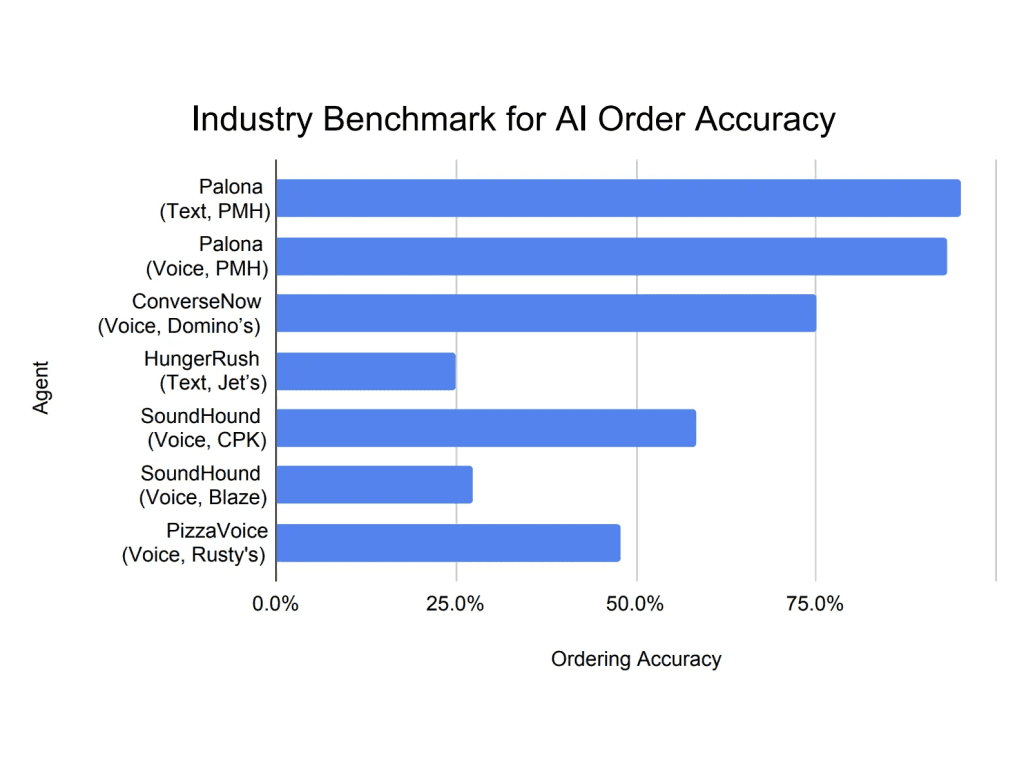 Figure 3. Ordering accuracy of the agents. Our agent, Jimmy, achieves state-of-the-art accuracy between 93.3% and 95.0%. This performance surpassed the second-best on-the-market product, with only 75.0% accuracy. The reason behind Jimmy’s accuracy is his underlying design to handle all possible customizations of pizza toppings and sauces, as well as diverse combinations of pizzas and other food items.
3.2 Failure AnalysisTo identify areas of improvement for each agent, we analyzed the test results and summarized the common reasons for failure. Palona.ai for PMH:
ConverseNow for Domino’s Pizza:
HungerRush for Jet’s Pizza:
SoundHound for CPK:
SoundHound for Blaze Pizza:
PizzaVoice for Rusty’s Pizza:
ConclusionPizza ordering may seem simple, but with the high-level customizations, order adjustments, and real-world requests push AI ordering systems to their limits. Inaccurate orders will lead to frustrated customers, operational headaches, and potentially, lost revenue. As new AI technology develops every day, we’ll continuously update our benchmark to hold ourselves, and the entire industry up to standard. |
Palona AI
I'm a marketer who loves to talk about artificial intelligence and food & drink. Subscribe to my newsletter.
Our robot may have won the popularity contest at the California Restaurant Show. It roamed the floor, joined us onstage and posed for more photos than the rest of the Palona team combined. We are still deciding whether selfie volume qualifies it for commission. But the biggest takeaway from the show was clear: Invisible demand is real. It appears in missed calls during a busy shift, catering inquiries that never receive a response and guests who give up when placing an order becomes too...
The physical world is not a collection of isolated objects. It is a stream of interactions. A customer operating a vending machine.A guest occupying a table.An employee handling food.A container left on the floor.A person looking at a menu board.A car entering another vehicle’s blind spot.A robot aligning a tool with an object. In each case, the important signal is not the presence of a single object. The value comes from understanding how people, objects, places, and processes relate to each...
Spain won the World Cup this Sunday in dramatic fashion, securing a 1-0 win against Argentina with a goal in the 106th minute. Congratulations to Spain, and my apologies to the Argentina fans reading this. But aside from stellar soccer, the World Cup also brought an interesting development to the restaurant industry. For 6 weeks, restaurants ranging from quick service to fine dining started airing the game. The result was watch parties that rivaled those of sports bars. The best part? It...